
The use of video games in the classroom is a controversial topic. Katie Salen mentions that when people think about video games, or see children playing them, that they see it as “a waste of time” (2010). But we know that video games – when carefully selected by the classroom teacher – can help students develop skills such as critical thinking, as well as problem -solving (Kangas, Koskinen & Krokfors, 2017). Not only that, but we also have research showing that game-based learning is beneficial to student learning (Mayer, 2019).
But what if we ask the students to make the game instead? Not only would we be helping them develop the aforementioned skills, but we would also be helping them to develop computational thinking skills and creative thinking skills. There are many technologies available currently to teachers and students that allow for activities that involve game creation and coding. One of the more popular and accessible technologies is Scratch. Scratch gives students the tools to create their own simple video games by using the Blockly coding language. Scratch is excellent for introducing coding to students as it is user friendly and can be translated into other coding languages (Python, JavaScript, C++ are just a few examples).
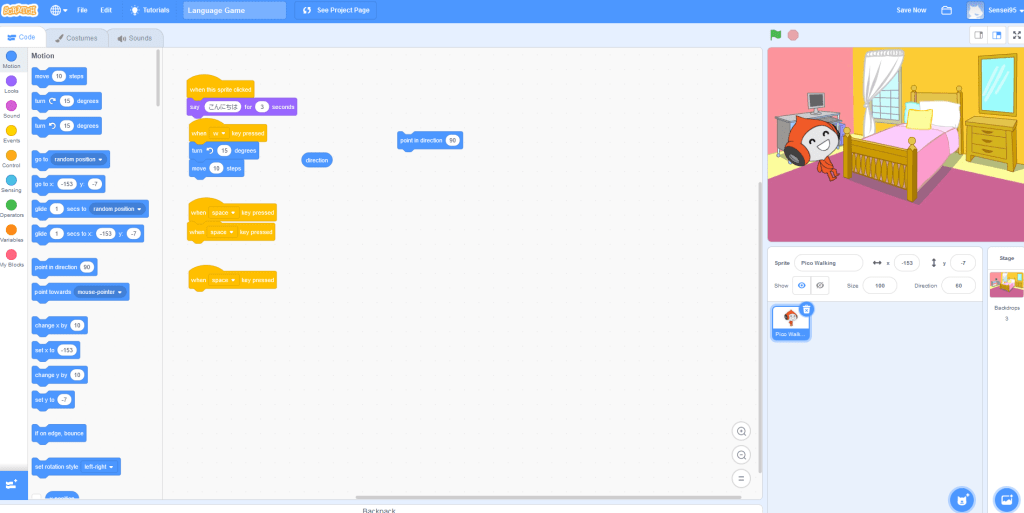
Prensky (2008) discusses how it is important to have students create educational games as they are the ones that will be playing them. It also gives students agency over their learning, and a product that they can show off at the end of their work. “With imagination and creativity any and every topic can be approached through some type of game” (Prensky, 2008). Coding and game creation can give students many creative options for different kinds of problems they might want to solve through a game.
One of the major issues though, with game creation, is the issue of accessibility. Not all students will have access to the technologies offered. Some students may have physical disabilities that prevent them from engaging in game-based learning and game creation. Some gaming companies are creating games that can help people access games and gaming. Somethin’ Else is a game developer that created ‘Papa Sangre‘, an audio only game that was created as intentionally blind-accessible.
I think that having students focus on these issues while creating their own games is a great way to include gaming, creativity and problem-solving in the classroom.
References:
Kangas, M., Koskinen, A., & Krokfors, L. (2017). A qualitative literature review of educational games in the classroom: The teacher’s pedagogical activities. Teachers and Teaching, 23(4), 451-470.
Mayer, R. E. (2019). Computer Games in Education. Annual Review of Psychology, 70, 531-549.
Prensky, M. (2008). Students as designers and creators of educational computer games: Who else? British Journal of Creative Technology, 39(6), 1004-1019.
Salen, K. (2010, July 29). Katie Salen on Learning with Games [Video file]. Retrieved from https://www.youtube.com/watch?v=xV_VlhV99EA
 Digital Creativity and Learning
One reply on “Game-based Learning and Creativity in the Classroom”
Hey Courtney, well done on such an interesting and well-structured post. I agree that it is crucial for educators to carefully select appropriate educational computer games that can develop critical thinking and problem-solving skills in students. Fortunately, we live in a time where there is a wide range of digital tools and software applications that enable students to be the producers and creators of their own games. Scratch does seem like a good application for students to create their own simple video game through coding. It seems like you were able to successfully create your own game through scratch, did you come across any challenges in the process? Overall, your digital games blog post is very neat, succinct, and pleasing to read. Good job once again!
LikeLike